
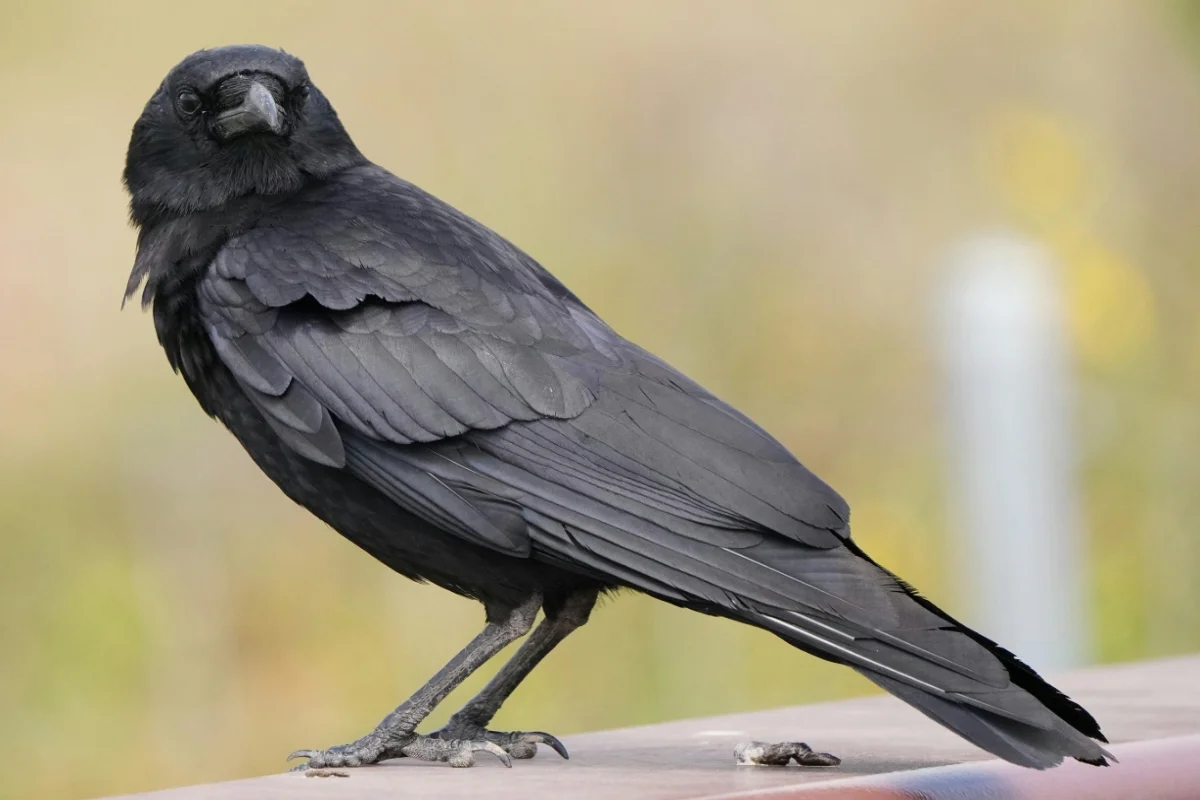
American Crow
The American Crow (Corvus brachyrhynchos) is one of the most familiar and intelligent birds of North America. With its glossy black feathers, loud calls, and sharp intelligence, this bird is commonly seen in forests, farmlands, towns, and even busy cities. The American crow belongs to the Corvidae family, a group that includes ravens, jays, and magpies, all known for their remarkable problem-solving abilities.
Despite often being misunderstood as a noisy or troublesome bird, the American crow plays an important role in the ecosystem and has a fascinating social and cognitive life.
Scientific Classification and Origin
The American crow was scientifically described in 1822 by German ornithologist Christian Ludwig Brehm. Its scientific name, Corvus brachyrhynchos, comes from Greek words meaning “short-billed crow.” Genetic studies suggest that the American crow diverged from its Eurasian relatives, such as the carrion crow and hooded crow, around five million years ago.
Today, “American crow” is the officially accepted name by the International Ornithologists’ Union.
Physical Appearance and Identification
The American crow is a medium to large-sized bird with a strong and confident build. Its entire body is covered in jet-black feathers, which often shine with a purple or bluish iridescence when seen in sunlight. The legs, feet, eyes, and bill are also black, giving the bird a uniform appearance.
Adult American crows usually measure between 40 and 53 centimeters in length, with a wingspan ranging from 85 to 100 centimeters. Their weight can vary widely depending on region and season, generally falling between 316 and 620 grams. Males are typically slightly larger than females, though the difference is subtle.
American crows are often confused with ravens. However, ravens are noticeably larger, have heavier bills, wedge-shaped tails, and deeper, croaking calls. Compared to fish crows, American crows are bulkier and do not fluff their throat feathers as prominently while calling.
Voice and Communication
The most recognizable sound made by the American crow is its loud and sharp “caw-caw-caw.” This call is used for a variety of purposes, including warning others of danger, maintaining contact with family members, and defending territory.
American crows are highly vocal birds and can produce a wide range of sounds beyond their usual calls. They are known to mimic other birds, animals, and even human-made noises. Their ability to communicate complex information through calls helps them survive in both wild and urban environments.
Intelligence and Cognitive Abilities
American crows are widely regarded as one of the most intelligent bird species in the world. Their brain-to-body size ratio is comparable to that of great apes and even humans. Although birds lack a neocortex, crows use a brain region called the pallium to perform advanced cognitive tasks.
Studies have shown that American crows can recognize and remember individual human faces, especially those associated with danger. They are capable of problem-solving, planning for the future, and learning from experience. Young crows spend several years learning survival skills from their parents and family members.
Crows have also been observed using and modifying tools to obtain food. They may drop nuts on roads for cars to crack, use sticks to extract insects, or manipulate objects creatively. Play behavior, such as sliding on snow or rooftops, further highlights their advanced intelligence.
Lifespan and Survival
In the wild, the average lifespan of an American crow is about 7 to 8 years, though many die earlier due to disease, predation, or human activity. In captivity, where threats are reduced, American crows have been known to live up to 30 years.
One of the most significant threats to their survival is the West Nile virus, which has caused major population declines since its introduction to North America in 1999.
Distribution and Habitat
The American crow has an extensive range covering most of North America. It is found from the Pacific Coast to the Atlantic Coast, throughout much of Canada and the United States, and into northern Mexico. It has also been recorded on islands such as Bermuda and Saint-Pierre and Miquelon.
This species is extremely adaptable and can live in almost any habitat except the tundra. American crows inhabit forests, grasslands, agricultural fields, parks, suburbs, and large cities. Their ability to coexist with humans has allowed their population to remain strong despite environmental changes.
Migration and Roosting Behavior
Most American crows in the United States are year-round residents, while many Canadian populations migrate south during winter. Outside the breeding season, crows often gather at night in large communal roosts, which may contain thousands or even millions of birds.
These massive roosts provide warmth, safety from predators, and opportunities for social interaction.
Diet and Feeding Habits
American crows are omnivorous and opportunistic feeders, meaning they eat almost anything available. Their diet includes insects, worms, seeds, grains, fruits, nuts, small mammals, frogs, eggs, and nestlings of other birds. They also feed on carrion and stranded fish along shorelines.
In urban areas, American crows frequently consume human food scraps and visit garbage dumps and bird feeders. While this behavior sometimes causes conflict with humans, it also demonstrates their adaptability and intelligence.
Reproduction and Social Structure
American crows are socially monogamous and practice cooperative breeding, a rare behavior among birds. Mated pairs often remain together for life, and their offspring from previous years may stay with the family to help raise new chicks.
The nesting season usually begins in early spring. Nests are large, bulky structures made of sticks and are typically built high in trees. Females lay three to six eggs, which are incubated for about 18 days. Young crows usually leave the nest after about five weeks but continue to depend on their parents for several months.
Predators and Threats
Eggs and nestlings are vulnerable to predators such as snakes, raccoons, hawks, owls, and domestic cats. Adult crows face fewer natural predators but may be attacked by large raptors like eagles and hawks.
Human activities, including hunting, habitat disturbance, vehicle collisions, and disease outbreaks, remain the biggest threats to American crows.
West Nile Virus and Bioindicator Role
American crows are highly susceptible to the West Nile virus, which has caused local population declines of up to 70 percent in some areas. However, they cannot transmit the virus directly to humans. Because they are so sensitive to the disease, dead or dying crows are often used as bioindicators to track the presence of the virus in an area.
Conservation Status
Despite population declines in certain regions, the American crow is classified as Least Concern by the IUCN. Its total population is estimated to be around 31 million individuals, and its wide distribution and adaptability help ensure its long-term survival.
Cultural Significance
Throughout history, crows have held powerful symbolic meanings in human cultures. They are often associated with death, mystery, and bad luck in Western traditions, while many Native American cultures view crows as symbols of intelligence, transformation, and good fortune.
American crows also appear in folklore, mythology, and classic fables, where they are often portrayed as clever and resourceful creatures.
Conclusion
The American crow is far more than just a common black bird. It is a highly intelligent, social, and adaptable species that has successfully thrived alongside humans. From its advanced problem-solving abilities to its complex family structure, the American crow continues to fascinate scientists and bird enthusiasts alike.
Understanding and appreciating this remarkable bird helps us recognize its important role in nature and its place in human culture.
Read Next: King Penguin
References
https://en.wikipedia.org/wiki/American_crow