

Bush Dog
(Speothos venaticus)
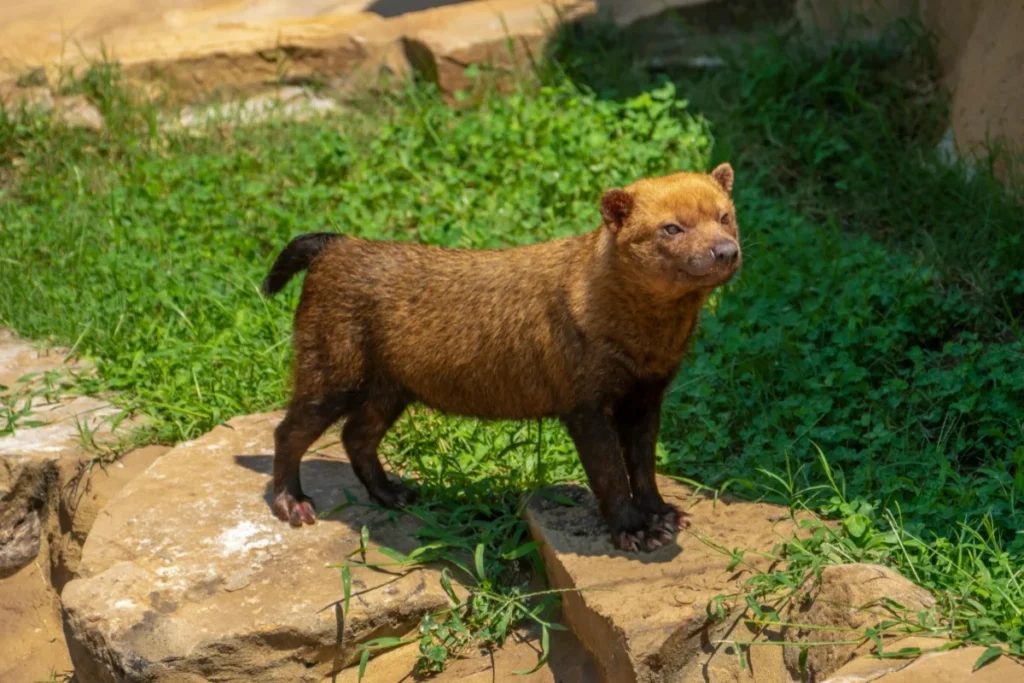
Scientific Classification
Common Name: Bush Dog
Scientific Name: Speothos venaticus
Kingdom: Animalia
Phylum: Chordata
Class: Mammalia
Order: Carnivora
Family: Canidae
Description
The bush dog is a rare and elusive wild wild canine native to Central and South America. It has a long, soft coat of brownish to tan fur, with lighter reddish tones on the head and back and darker underparts. Unlike most dogs, the bush dog has short legs, a compact body, a short snout, and small rounded ears. It is well adapted for a semi-aquatic lifestyle, with partially webbed toes that allow it to swim efficiently. Bush dogs are highly social animals that live and hunt in small family packs.
Size
Adult bush dogs have a head–body length of about 57–75 cm (22–30 inches), with a short tail measuring 12.5–15 cm (5–6 inches). Their shoulder height typically ranges from 20–30 cm (8–12 inches).
Weight
Bush dogs are relatively small canids, weighing between 5 and 8 kilograms (11–18 pounds). Despite their small size, they are capable of hunting prey much larger than themselves through cooperative pack hunting.
Sex Differences
Males and females look similar, with no clear size or color differences. Both have strong scent glands used for communication.
Diet
Bush dogs are carniv carnivores that hunt rodents like pacas and agoutis. In packs, they can also hunt larger animals.
Breeding
They breed year-round. After a 65–83 day gestation, females give birth to 3–6 pups, which are fatal blind at birth.
Life Span
Bush dogs can live up to 10 years mostly in captivity.
Range
Bush dogs are found from Costa Rica in Central America through much of South America east of the Andes, including countries such as Colombia, Venezuela, Brazil, Peru, Bolivia, Paraguay, and northern Argentina.
Habitat
They prefer tropical forests, wetlands, and river-side areas, but can also survive in as dry regions.
Conservation Status
Near Threatened (IUCN) due to habitat loss, prey decline, and diseases from domestic dogs.
Fun Facts
1. The bush dog is the only living species in the genus Speothos, making it a unique member of the dog family.
2. It is sometimes called the “vinegar dog” because of the strong-smelling scent produced by its glands.
3. Bush dogs have partially webbed feet, an unusual feature for canids, which helps them swim and hunt near water.
4. They are among the most social canids in South America, living in tightly bonded family packs.
5. Genetic studies suggest their closest living relatives may be the maned wolf or the African wild dog, despite living on different continents.
6. Bush dogs were once thought to be extinct, as they were first described from fossil remains before living individuals were discovered.
Ecology and Conservation
Bush dogs play an important role in their ecosystems by helping regulate populations of medium-sized rodents and other prey species. Their cooperative hunting behavior reflects a complex social structure that depends on large, undisturbed territories.
Conservation efforts are still developing due to the species’ elusive nature. Traditional camera trapping often fails, so researchers now use scent-detection dogs to locate bush dog dens and track their movements. Protected areas such as the Yasuni Biosphere Reserve and recent sightings in Costa Rica suggest that with improved habitat protection and disease control, bush dog populations may stabilize in the future.
Bibliography
Lund, P. W. (1842). Description of fossil mammals from Brazil.
IUCN Red List of Threatened Species. Speothos venaticus.
Wikipedia contributors. “Bush dog.” Wikipedia, The Free Encyclopedia.