
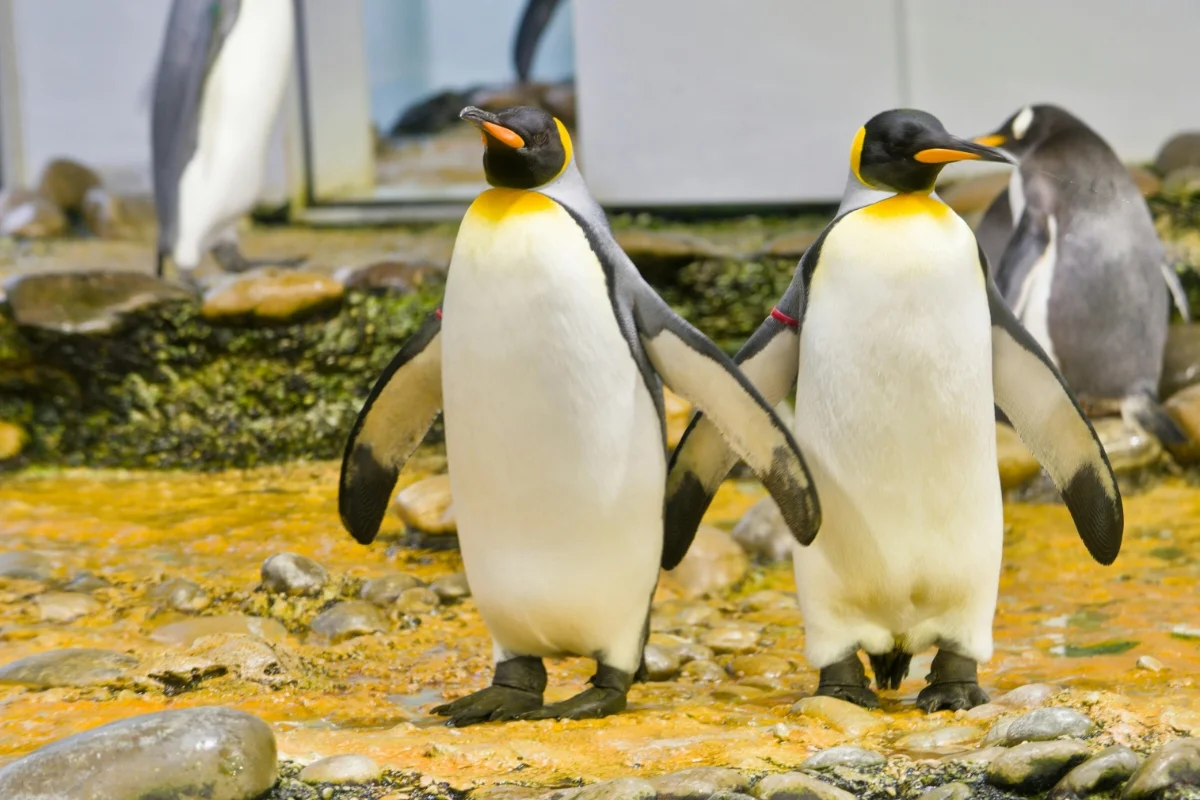
King Penguin
The King Penguin is one of the largest and most beautiful penguin species in the world. It is the second-largest penguin, just smaller than the Emperor Penguin. King penguins are famous for their bright orange-yellow markings, tall posture, and calm behavior. They are mainly found on subantarctic islands in the Southern Ocean.
Scientific Classification
- Kingdom: Animalia
- Phylum: Chordata
- Class: Aves
- Order: Sphenisciformes
- Family: Spheniscidae
- Genus: Aptenodytes
- Species: Aptenodytes patagonicus
Appearance
King penguins stand 70–100 cm tall and weigh between 9–18 kg. They have a black back, white belly, and bright orange patches on the neck and upper chest. Their long, straight bill and sleek body make them easy to recognize. Male and female king penguins look almost the same, though males are slightly larger.
Habitat and Distribution
King penguins live and breed on subantarctic islands such as:
- South Georgia
- Falkland Islands
- Crozet Islands
- Kerguelen Islands
- Macquarie Island
They prefer cold oceans but usually avoid the extreme Antarctic interior.
Diet
King penguins mainly eat:
- Lanternfish
- Squid
- Krill
They are excellent divers and can dive over 300 meters deep to catch food. Most hunting happens during the daytime.
Behavior
- King penguins are flightless birds but excellent swimmers.
- They can swim at speeds of 6–10 km/h.
- On land, they walk with a waddling gait or slide on their belly, called tobogganing.
- They live in huge colonies, sometimes with over 100,000 pairs.
Breeding and Life Cycle
King penguins have a long breeding cycle of 14–16 months.
- The female lays one egg
- Both parents take turns incubating the egg on their feet
- Chicks form large groups called crèches for protection
- Young penguins take more than one year to become independent
Predators
Natural predators of king penguins include:
- Leopard seals
- Orcas (killer whales)
- Giant petrels
- Skuas
Most attacks happen in the ocean or on young chicks.
Conservation Status
The king penguin is currently listed as Least Concern by the IUCN.
However, climate change and overfishing threaten their food supply. Rising ocean temperatures may force penguins to travel farther to find food, which could affect future populations.
Relationship with Humans
- King penguins were hunted in the past for oil and meat
- Today, they are fully protected
- They are popular in zoos and aquariums worldwide
- Famous king penguins include Sir Nils Olav (Edinburgh Zoo mascot) and Pesto from Melbourne Aquarium
Interesting Facts About King Penguins
- King penguins cannot build nests
- They balance their egg on their feet
- They can stay underwater for up to 9 minutes
- Their colonies stay active all year round
Conclusion
The King Penguin is a majestic and intelligent seabird that plays an important role in the Southern Ocean ecosystem. With proper conservation and climate protection, this stunning species can continue to thrive for generations to come.
Read Next: Peacock
References
https://en.wikipedia.org/wiki/King_penguin